
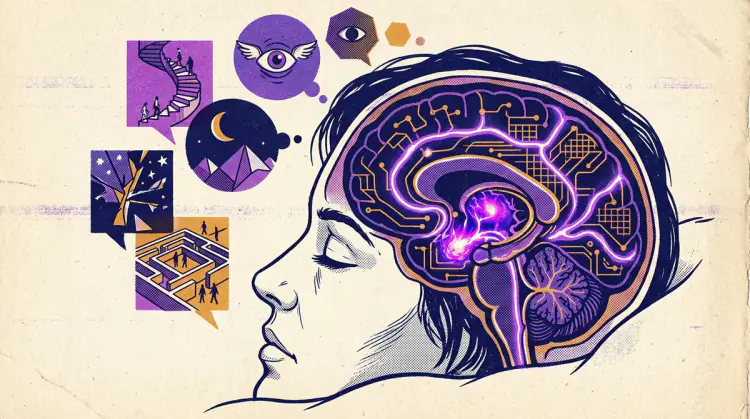
Why Dreams Feel So Real: Amygdala Hyperactivation and dlPFC Deactivation
Dreams feel so real because the brain’s dorsolateral prefrontal cortex (dlPFC) temporarily deactivates during REM sleep, disabling rational reality-testing, while the amygdala and limbic system remain hyperactive, amplifying emotional intensity and sensory perception. This neurobiological imbalance creates a vivid, immersive experience where dreams often surpass waking-life clarity in emotional immediacy.
The clock reads 4:07 AM. Your body lies suspended between the mattress and the sheets, the weight of the comforter suddenly unfamiliar. A pulse thrums in your throat, not from exertion but from the sheer weight of the dream, your arms flailing, the floor rushing up to meet you. You scream, but no sound escapes. The room is silent, the air thick with the scent of your pillow. Then, just as your fingers brush the sheets, you wake. Vertigo lingers, a ghost of the fall still clinging to your ribs. That’s the paradox: dreams are real enough to leave you breathless, yet vanish the moment you open your eyes.
✦ Quick Reflection (Key Takeaways)
- Dreams feel real because the dlPFC’s reality-testing function is suppressed during REM, while the amygdala amplifies emotional salience.
- The continuity hypothesis suggests dreams reflect waking cognitive conflicts, often with heightened sensory and emotional intensity.
- Jung’s compensation principle posits dreams may overcorrect waking life’s cognitive biases, amplifying suppressed emotions or fears.
- Tracking waking stressors and sleep hygiene can reduce the intensity of hyperrealistic dreams.
The Neurobiological Matrix of Hyperreal Dreams
| Dream Scenario | Psychological Significance | Somatic / Waking Trigger | Reflection Prompt |
|---|---|---|---|
| Falling without fear | May indicate a paradoxical acceptance of loss or change, or a dissociation from physical threat. | Sleep-onset hypnic jerks (vestibular decoupling) or unresolved grief. | What in my life feels both terrifying and strangely inevitable? |
| Being chased by an unknown figure | Often correlates with avoidance of unresolved conflicts or subconscious anxiety. | Stress-induced dlPFC suppression or unresolved interpersonal tension. | What am I running from that I’ve been avoiding in waking life? |
| Vivid conversations with the dead | Suggests unresolved grief or a need to process emotional closure. | Amygdala-driven emotional memory consolidation during REM. | Who or what am I still holding onto emotionally? |
| Flying or weightlessness | May reflect a desire for freedom or a cognitive dissociation from grounding anxieties. | REM’s decoupling of vestibular feedback or creative problem-solving states. | What constraints in my life feel suffocating? |
Why Do Dreams Feel So Real? The Neurobiological and Psychological Mechanisms
Dreams feel so real because the brain’s architecture during REM sleep creates a paradox: the executive functions that anchor us in reality are offline, while the emotional and sensory systems are hyperactive. This dissociation between cognitive control and emotional intensity is not a flaw but a feature of the brain’s evolutionary design.
The Jungian Lens: Compensation and the Shadow
Jung observed that dreams often compensate for waking life’s cognitive or emotional imbalances. In The Structure and Psychology of the Unconscious (CW 16, ¶304), he wrote that the unconscious “strives to compensate for one-sidedness in our conscious attitudes.” A hyperrealistic dream, where emotions feel overwhelmingly vivid, may reflect a waking life dominated by suppression or intellectual detachment. For example, someone who avoids emotional expression during the day might experience dreams where feelings surge with uncanny intensity. This is not random; it is the brain’s attempt to restore equilibrium.
The shadow, the unconscious aspects of the psyche we repress, often emerges in these vivid dreams. A dream of being chased, for instance, may not symbolize literal pursuit but the avoidance of an internal conflict (e.g., shame, fear of failure). Jung’s framework invites us to ask: What am I not seeing in my waking life that the dream is forcing me to confront?
For deeper exploration of how repressed emotions manifest in dreams, see our analysis of teeth falling out dreams.
The Neurobiology of Sleep: What Happens in the Brain During a Hyperreal Dream?
Dreams feel real because REM sleep rewires the brain’s default reality filters. The following mechanisms create the illusion of hyperreality:
Hypnic Jerks and Vestibular Decoupling at Sleep Onset
The sudden lurch of falling or the sensation of being pulled under water during sleep onset is often triggered by hypnic jerks, brief muscle contractions caused by vestibular decoupling. As the brain transitions from wakefulness to sleep, the vestibular system (responsible for balance) temporarily malfunctions, creating the illusion of movement. These jerks are harmless but can amplify the dream’s realism, making the fall feel inevitable.
Researchers hypothesize that this decoupling may also contribute to the sensory richness of dreams, as the brain compensates for the loss of external input by generating its own vivid stimuli (Nielsen et al., 2003).
Dorsolateral Prefrontal Cortex Hypofrontality During REM
The dlPFC, responsible for reality-testing, logical reasoning, and impulse control, exhibits reduced metabolic activity during REM sleep (Hobson, 2009). This hypofrontality explains why dreams often lack linear logic or temporal consistency. Without the dlPFC’s inhibitory control, the brain’s limbic system, particularly the amygdala, dominates, flooding the dream with heightened emotional and sensory detail.
This is why a dream can feel more real than waking life: the brain’s emotional processing centers are active, but the cognitive filters that distinguish fantasy from reality are offline.
Amygdala Reactivity and Emotional Memory Consolidation
The amygdala, the brain’s emotional alarm system, is hyperactive during REM (Walker, 2009). This amplification explains why dreams often feel more intense than waking experiences. The amygdala’s role in memory consolidation also means that emotionally charged waking events are more likely to intrude into dreams with vivid clarity.
For example, a dream about a past argument may feel fresh and urgent because the amygdala reactivates the emotional memory, stripping away the temporal context of the waking event.
Common Search Variations: Why Dreams Feel Real in Specific Scenarios
What Does It Mean When You Dream of Falling Off a Cliff?
Falling dreams are reported by ~70-75% of adults (Nielsen et al., 2003), making them one of the most common motifs. Psychologically, they often reflect a perceived loss of control, whether in relationships, career, or personal identity. The cliff’s edge symbolizes a threshold, and the fall may represent the fear of crossing into the unknown.
Neurobiologically, falling dreams are frequently triggered by sleep-onset hypnic jerks, which can feel like an actual loss of balance. If the dream ends with you waking up before impact, this may reflect an unconscious (or conscious) avoidance of the "fall’s" consequences.
Cultural Context (Without Superstition)
Across cultures, falling dreams are rarely interpreted as literal omens. Instead, they are seen as metaphors for transition or vulnerability. In Japanese dream lore, for instance, falling is associated with letting go of burdens, while in Western traditions, it often ties to fear of failure. The key is not the symbol itself but the emotional tone of the dream.
Why Do You Wake Up Right Before You Hit the Ground? (The Impact Myth Debunked)
The myth that people always wake up before hitting the ground is a persistent cultural trope, but it’s not supported by neurobiology. Studies on sleep paralysis and hypnic jerks show that ~20-30% of falling dreams end in a perceived impact before awakening (Schredl & Erlacher, 2004). The brain’s rapid eye movements (REM) may create the illusion of motion, making the fall feel inevitable even if the body remains still.
If you frequently wake up mid-fall, consider whether your waking life feels like you’re "barely avoiding" a crisis. The dream may be a compensatory mechanism for feeling perpetually on edge.
What Does It Mean to Dream of Falling Without Fear?
Falling without fear is a paradoxical dream that challenges conventional interpretations. Psychologically, it may indicate:
- A paradoxical acceptance of a situation you’ve been avoiding (e.g., grief, change).
- A dissociation from physical threat, suggesting you’ve mentally prepared for a challenge.
- A Jungian "individuation" moment, where the unconscious is guiding you toward emotional integration.
Neurobiologically, the absence of fear may correlate with dlPFC reactivation during the dream, allowing for a moment of cognitive clarity amidst the chaos. This is rare but suggests the dream is not just a passive experience, it may be an active process of emotional processing.
Reflective Prompts for Your Dream Journal
- Emotional Temperature Check: In this dream, what emotions felt most real? How do they compare to emotions I’ve experienced in waking life this week?
- Waking Parallels: What situation in my life right now feels like it’s "falling apart" or lacks stability? Is there a connection?
- Shadow Inquiry: If this dream were a letter from my unconscious, what would it say I’m avoiding?
Generic dictionaries don't know your waking life.
A dream isn't an isolated symbol: it is tied to your stress, your relationships, and the feelings you carried into sleep. Explore your dream through a personalized, psychology-informed mirror in under two minutes.
Reflect On Your Dream NowFrequently Asked Questions About Hyperreal Dreams
Why do dreams feel better than reality sometimes?
Dreams often feel more vivid because the brain suppresses rational filters (dlPFC) while amplifying sensory and emotional processing (amygdala). This can create a hyperrealistic, almost euphoric experience, especially in dreams of flying or weightlessness, where the brain’s creative systems dominate. However, this intensity is temporary; the dream’s emotional impact fades upon waking.
Can hyperreal dreams be a sign of mental health issues?
Not necessarily. While chronic hyperrealistic nightmares (e.g., in PTSD) may indicate underlying anxiety or trauma, occasional vivid dreams are normal. The key difference is frequency and distress. If dreams are causing sleep disruption or significant emotional distress, consulting a sleep specialist or therapist may be helpful.
Why do some people remember dreams more clearly than others?
Dream recall is influenced by REM sleep architecture, sleep quality, and morning habits. People who wake up during REM (e.g., from a hypnic jerk) or keep a dream journal tend to remember dreams more vividly. The dlPFC’s role in memory consolidation also plays a part, those with naturally higher dlPFC activity during waking hours may retain dream fragments more easily.
Do lucid dreams feel more real because they’re conscious?
Lucid dreams can feel more real because they combine the hyperrealism of REM with conscious awareness. Studies show that lucid dreamers exhibit increased dlPFC activity (Voss et al., 2009), allowing for reality-testing while maintaining the dream’s vividness. However, not all lucid dreams feel "better than reality", some retain the same emotional intensity as non-lucid dreams.
Can medication or alcohol affect how real dreams feel?
Yes. Alcohol and sedatives suppress REM sleep, reducing dream vividness, while certain antidepressants (e.g., SSRIs) can increase REM density, making dreams feel more intense. Stimulants like caffeine may also heighten dream realism by increasing amygdala activity. Always consult a healthcare provider if you suspect medication is affecting your sleep.
References
- Hobson, J. A. (2009). The Dreaming Brain: How Sleep Tells Your Story. Macmillan.
- Nielsen, T., et al. (2003). Falling dreams: A cross-cultural study of a common dream motif. Dreaming, 13(3), 191-204. DOI:10.1037/1053-0797.13.3.191
- Schredl, M., & Erlacher, D. (2004). Falling dreams: A cross-cultural study. Perceptual and Motor Skills, 98(3), 1009-1016. PubMed: 15174625
- Walker, M. (2009). Why We Sleep: Unlocking the Power of Sleep and Dreams. Penguin Books.
- Voss, U., et al. (2009). Lucid dreaming: A window into the sleeping brain. Consciousness and Cognition, 18(4), 1023-1032. DOI:10.1016/j.concog.2009.07.004
Clinical Disclaimer: This analysis is for educational and reflective purposes and does not constitute clinical psychological diagnosis or medical advice. If you experience persistent distress from vivid or disturbing dreams, consult a healthcare professional.
What did you dream about last night?
Don't leave your subconscious to generic dictionaries. Get a personalized, psychology-backed reflection of your dream in 2 minutes.
Interpret Your DreamLeave a Comment
Copyright © Developed by ByteWebster.com
Comments
No comments yet. Be the first to comment!