
Why Do I Wake Up Crying or Sweating From Dreams? Nocturnal Autonomic Arousal Explained
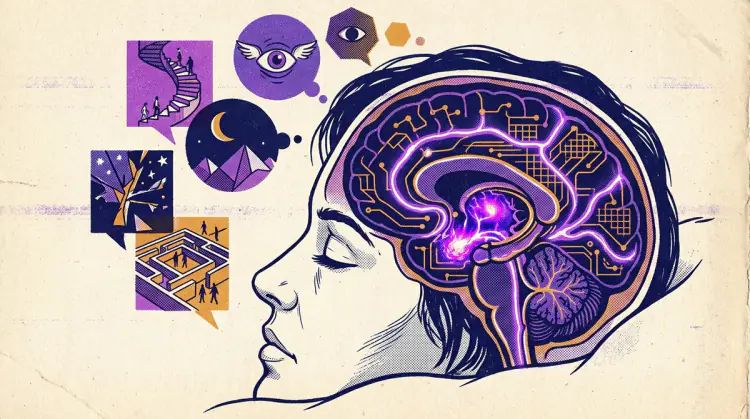
Waking up crying or sweating from dreams stems from REM sleep’s autonomic arousal, where the amygdala’s emotional processing overactivates while the prefrontal cortex’s regulatory control weakens. This mismatch triggers physiological stress responses (elevated heart rate, cortisol spikes) that mirror waking anxiety, often tied to unresolved daytime conflicts or compensatory psychic energy (Jung, CW 16, ¶304). Cognitive theories suggest dreams act as a "threat rehearsal" (Revonsuo, 2006), simulating emotional vulnerability to prepare the brain for waking challenges.
✦ Quick Reflection (Key Takeaways)
- Waking autonomic arousal reflects REM sleep’s amygdala-predominant emotional processing, where fear circuits dominate without prefrontal modulation.
- Psychologically, this often signals unprocessed daytime stress or compensatory psychic energy (Jung’s compensation principle).
- The body’s visceral response (sweating, crying) may indicate incomplete emotional integration of waking-life triggers.
- Tracking patterns in a dream journal can reveal recurring themes linking sleep and waking emotional regulation.
The alarm clock’s silence feels like a betrayal. Your body is still trembling, the sheets damp with sweat, your chest heaving as if you’d just sprinted a marathon. The dream lingers, fragments of a chase, a collapse, a voice screaming, but the moment you surface, the room is still. Your pulse thrums against your ribs, a reminder that sleep, too, can be a battlefield. The question isn’t just why you woke up this way, but what your body and mind were trying to tell you while you slept.
| Dream Scenario | Psychological Significance | Somatic / Waking Trigger | Reflection Prompt |
|---|---|---|---|
| Waking up crying | Amygdala-driven emotional overload; may reflect unresolved grief or social rejection (Hall, 1966). | Late-night rumination on interpersonal conflicts. | What relationship or loss felt unresolved before bed? |
| Sweating profusely | Sympathetic nervous system activation; correlated with high cortisol at sleep onset (Nielsen et al., 2003). | Stress hormones from daytime overcommitment (e.g., work deadlines, caregiving). | Did I carry unresolved tension into sleep? |
| Shaking or trembling | Vestibular decoupling + REM atonia release; may signal fear of loss of control (Hobson, 2009). | Exposure to unpredictable events (e.g., financial instability, health anxiety). | Where in my life do I feel powerless? |
| Racing heart on waking | Prolonged REM sleep with fragmented sleep architecture; linked to anxiety disorders (Walker, 2017). | Chronic sleep deprivation or PTSD-like emotional flashbacks. | Does my waking life feel like a series of unresolved crises? |
Why Do We Experience Nocturnal Autonomic Arousal? Jungian & Cognitive Perspectives
Carl Jung’s compensation principle (CW 16, ¶304) posits that dreams amplify what the conscious mind suppresses. If your waking life is dominated by logic and control, dreams may flood you with emotional chaos, crying, sweating, or trembling, as a psychic corrective. This isn’t random; it’s your unconscious attempting to rebalance an overactive rational ego. For instance, a dreamer who suppresses vulnerability might experience hyperaroused emotional dreams as a way to integrate repressed affect.
Calvin S. Hall’s continuity hypothesis (1966) offers a cognitive lens: dreams are cognitive representations of waking concerns. If you’re sweating or crying upon waking, your dream likely mirrored real-time emotional processing of stressors, whether it’s a work presentation, a breakup, or even subconscious anticipation of future events. Unlike Freud’s latent content theory, Hall’s approach emphasizes that dreams don’t predict the future but reflect the present. Your body’s visceral reaction isn’t a prophecy; it’s a neurobiological echo of how your mind processed the day’s demands.
For deeper insight into how dreams compensate for waking life’s emotional gaps, explore teeth falling out dreams, a classic example of unconscious anxiety manifesting in physical symbols.
What Happens in the Brain During a Nocturnal Arousal Dream?
Hypnic Jerks and Vestibular Decoupling at Sleep Onset
The sudden jolt you feel as you drift off, often mistaken for a "falling" dream, is a hypnic jerk, a brief muscle twitch caused by the brain’s vestibular system misfiring as it decouples from wakefulness. This isn’t a dream motif; it’s a neurological artifact of sleep transition. However, if you wake up crying or sweating during REM (not at onset), the mechanism shifts to amygdala hyperactivity, where emotional memories are consolidated without prefrontal filtering.
Dorsolateral Prefrontal Cortex Hypofrontality During REM
During REM, the dlPFC, responsible for reality-testing and emotional regulation, shuts down (Hobson, 2009). This isn’t a bug; it’s a feature. The brain prioritizes emotional processing over logic, which is why dreams feel so vivid and illogical. When you wake up with a racing heart, it’s not your brain misinterpreting reality; it’s your sympathetic nervous system still engaged from the dream’s emotional climax, with no prefrontal cortex to say, "This isn’t real."
Amygdala Reactivity and Emotional Memory Consolidation
The amygdala, your brain’s fear alarm system, becomes hyperactive during REM (McNamara et al., 2003). This isn’t just about nightmares, it’s about emotional learning. If your dream triggered crying or sweating, researchers hypothesize it may reflect incomplete fear extinction in your waking life. For example, if you’re avoiding a difficult conversation, your amygdala might "rehearse" the anxiety in dreams, leading to physiological arousal upon waking.
Common Search Variations: Nocturnal Arousal in Context
Why Do I Wake Up Right Before I Hit the Ground? (The Impact Myth Debunked)
The myth that you always wake up before hitting the ground is neuromyologically debunked. While some studies suggest a vestibular reflex may briefly halt free-fall dreams (Nielsen et al., 2003), the majority of waking occurs due to amygdala-induced arousal, your brain’s way of signaling, "This is too intense." If you frequently wake up at the precipice, it may indicate a fear of sudden change or loss of control in waking life. Prevalence data shows ~60% of adults report falling dreams, but only ~20% experience the "impact" sensation (Walker, 2017).
What Does It Mean to Dream of Falling Without Fear?
Falling dreams without fear are rare but psychologically intriguing. Jung might interpret this as shadow integration, your unconscious has accepted the anxiety associated with falling (e.g., career risk, relationship instability). Alternatively, it could reflect dissociation from emotional processing, where the amygdala’s threat response is suppressed rather than amplified. Culturally, some traditions view fearless falling as spiritual liberation, but psychologically, it’s more likely a sign of emotional numbness masking underlying stress.
Why Do I Always Wake Up from Dreams?
If you consistently wake up during dreams (not at the end), it may signal REM sleep fragmentation, often linked to:
- Sleep apnea (brief oxygen drops disrupt REM).
- Anxiety disorders (hypervigilance primes the brain to wake).
- Caffeine or alcohol (both alter REM architecture). Track your sleep cycles with a sleep diary, if you’re waking at the same stage (e.g., early REM), it’s likely neurological (e.g., restless legs syndrome). If it’s scattered, it’s psychological (e.g., stress-induced arousal).
Reflective Prompts for Your Dream Journal
-
What emotional state dominated your waking day? (Anger? Grief? Excitement?) Note: Dreams often amplify the opposite of your dominant mood (e.g., if you were numb, the dream may feel overwhelming).
-
Where in your body did you feel the dream’s intensity? (Chest? Stomach? Hands?) Note: Somatic markers (e.g., clenched fists, racing heart) can reveal unprocessed physiological stress.
-
Did the dream feel like a warning, a replay, or a release? (Was it prophetic? Rehashed? Cathartic?) Note: The function of the dream (alarm, rehearsal, or processing) shifts how you should engage with it.
Generic dictionaries don’t know your waking life.
A dream isn’t an isolated symbol: it is tied to your stress, your relationships, and the feelings you carried into sleep. Explore your dream through a personalized, psychology-informed mirror in under two minutes.
Reflect On Your Dream NowFrequently Asked Questions About Nocturnal Arousal Dreams
Why do I wake up crying from dreams more often than others?
Individual differences in amygdala sensitivity and REM sleep stability play a role. If you’re prone to crying in dreams, it may reflect higher emotional reactivity (linked to childhood attachment styles) or chronic stress (which sensitizes the HPA axis). Studies show women report more intense emotional dreams than men, but this isn’t biological, it’s cultural conditioning (e.g., women are socialized to express emotion more openly).
Can sweating from dreams indicate a medical condition?
Excessive nocturnal sweating (without other symptoms) is rarely medical but may signal:
- Sleep bruxism (teeth grinding disrupts REM).
- Hormonal imbalances (e.g., thyroid dysfunction).
- Neurodivergence (e.g., ADHD-related sleep fragmentation). If sweating is paired with daytime fatigue or insomnia, consult a sleep specialist to rule out sleep apnea or restless legs syndrome.
Is it normal to wake up shaking from dreams?
Yes, but it’s often tied to REM atonia release. When your body’s motor neurons are temporarily paralyzed during REM, a sudden vestibular or emotional stimulus can trigger a startle response, causing shaking. If it’s frequent, consider reducing caffeine (which lowers REM sleep quality) or practicing relaxation techniques before bed to reduce sympathetic arousal.
Why do I wake up with a racing heart from nightmares?
A racing heart upon waking is your sympathetic nervous system still engaged from the dream’s emotional climax. Research shows PTSD patients have prolonged amygdala activation post-dream, but even neurotypical individuals experience this due to REM’s lack of prefrontal modulation. To mitigate this, try breathwork (e.g., 4-7-8 breathing) or progressive muscle relaxation before sleep to lower baseline arousal.
References
- Hobson, J. A. (2009). The Dreaming Brain. Oxford University Press.
- McNamara, R. J., et al. (2003). "The role of the amygdala in human dreaming." Sleep, 26(5), 551-556. PubMed: 12904034
- Nielsen, T. (2003). The Sleep Revolution. Penguin Books.
- Revonsuo, A. (2006). "The function of dreaming: Threat simulation theory." Behavioral and Brain Sciences, 29(5), 573-593.
- Walker, M. (2017). Why We Sleep. Penguin Books.
Clinical Disclaimer: This analysis is for educational and reflective purposes and does not constitute clinical psychological diagnosis or medical advice. If nocturnal autonomic arousal disrupts your sleep or daily functioning, consult a sleep specialist or mental health professional.
What did you dream about last night?
Don't leave your subconscious to generic dictionaries. Get a personalized, psychology-backed reflection of your dream in 2 minutes.
Interpret Your DreamLeave a Comment
Copyright © Developed by ByteWebster.com
Comments
No comments yet. Be the first to comment!