
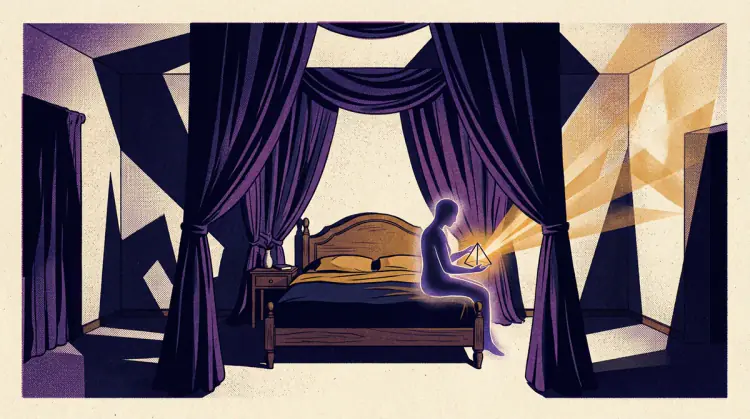
Sleep Paralysis and the Bedroom Intruder: REM Intrusion and Somatosensory Hallucinations
The shadow figure or intruder hallucination during sleep paralysis arises when REM sleep motor atonia intrudes into waking consciousness, triggering somatosensory threat hypervigilance. This phenomenon is linked to amygdala reactivity and the brain’s failure to suppress vivid, emotionally charged hallucinations due to dorsolateral prefrontal cortex hypofrontality. Psychologically, it may reflect unresolved daytime anxiety or compensatory shadow integration (Jung, CW 16, ¶304).
✦ Quick Reflection (Key Takeaways)
- The intruder hallucination is correlated with heightened amygdala reactivity during REM sleep, amplifying perceived threats.
- Sleep paralysis occurs when REM atonia fails to suppress motor function, creating a "limbo" state between dreaming and waking.
- Jung’s compensation principle suggests the shadow figure may symbolize repressed emotions or unconscious fears (CW 16, ¶304).
- Tracking triggers (stress, sleep deprivation, irregular sleep schedules) can help mitigate frequency.
The alarm clock’s glow fades, but your body refuses to move. The air is thick with the scent of lavender sheets, yet your breath comes shallow, trapped. A weight presses on your chest, not physical, but felt, and then, from the corner of your vision, a shape stirs. Not quite a person, not quite a shadow, it hovers just beyond the edge of your peripheral sight, its edges blurring like a half-remembered face. Your heart hammers. You know it’s not real, but your body doesn’t listen. This is sleep paralysis: the brain’s REM atonia, meant to paralyze your muscles so you don’t act out dreams, has slipped into wakefulness, leaving you trapped in a limbo where the mind invents threats the body can’t escape.
| Dream Scenario | Psychological Significance | Somatic / Waking Trigger | Reflection Prompt |
|---|---|---|---|
| Shadow figure looms at the foot of the bed | May reflect unresolved fears of intrusion (physical or emotional) into personal space or boundaries. | Sleep deprivation, irregular sleep cycles, or heightened stress hormones (cortisol). | What in my waking life feels like an "intrusion" I haven’t fully acknowledged? |
| Intruder touches or grabs you | Suggests a perceived violation of impulse boundaries or emotional safety (Hall’s cognitive mapping). | History of trauma, recent conflicts, or a sense of powerlessness in relationships. | Where do I feel my boundaries are being tested right now? |
| Figure morphs into a known person | Indicates unresolved relational tension or a "shadow" aspect of that person’s personality (Jung). | Daytime stress related to that individual or unresolved emotional labor. | What unspoken emotions do I associate with this person? |
| You try to scream but can’t | Symbolizes suppressed communication or fear of retaliation for expressing needs. | Chronic stress, workplace anxiety, or emotional repression. | What have I been afraid to say out loud? |
Why Do We Experience Shadow Figure Hallucinations During Sleep Paralysis? Jungian & Cognitive Perspectives
Sleep paralysis intruder hallucinations are not random, they emerge from the brain’s attempt to make sense of a physiological limbo state. Carl Jung described such experiences as manifestations of the shadow, the unconscious material that compensates for conscious overconfidence or repression (CW 16, ¶304). The shadow figure often embodies fears or desires the waking self has denied, particularly those tied to vulnerability or loss of control. For instance, a recurring intruder may parallel a real-life figure whose behavior feels predatory or invasive, or it may represent an internalized critique (e.g., self-doubt personified).
From a cognitive perspective, Calvin S. Hall’s continuity hypothesis posits that dreams, including sleep paralysis hallucinations, are cognitive representations of waking life concerns. The intruder figure may reflect perceived threats to impulse boundaries (e.g., emotional boundaries in relationships, career pressures, or even physical safety). Research shows that individuals with higher trait anxiety report more frequent sleep paralysis episodes, suggesting a link between hypervigilance and these hallucinations (Nielsen et al., 2003). For deeper exploration of how dreams map waking anxieties, see our analysis on being chased dreams.
What Happens in the Brain During Sleep Paralysis?
Sleep paralysis occurs when REM sleep’s motor atonia, normally suppressing muscle activity, fails to deactivate fully upon waking. This creates a paradoxical state where the brain is awake but the body remains partially paralyzed, a condition linked to dorsolateral prefrontal cortex (dlPFC) hypofrontality. The dlPFC’s reduced activity during REM sleep may impair reality-testing, allowing hallucinations to feel vividly real.
Hypnic Jerks and Vestibular Decoupling at Sleep Onset
Hypnic jerks (sleep-onset myoclonus) often precede sleep paralysis and may share neurobiological roots. These twitches occur due to vestibular decoupling, the brain’s sudden loss of proprioceptive input as you fall asleep, triggering a startle response (Hobson, 2009). In some cases, this decoupling may persist into REM, contributing to the disorientation of sleep paralysis.
Dorsolateral Prefrontal Cortex Hypofrontality During REM
The dlPFC’s reduced activity during REM sleep impairs executive functions like logical reasoning and threat assessment. This may explain why intruder hallucinations feel inevitable, the brain’s threat detection systems (amygdala) override the dlPFC’s ability to contextualize the hallucination as harmless (Maquet et al., 2005).
Amygdala Reactivity and Emotional Memory Consolidation
The amygdala, hyperactive during REM, amplifies emotional intensity and threat perception. Sleep paralysis intruders often evoke fear because the amygdala treats them as real threats, even though they lack physical presence. This aligns with Threat Simulation Theory (TST), which posits that REM sleep may rehearse threat responses (Revonsuo, 2000). However, in sleep paralysis, this rehearsal becomes intrusive, blending with waking consciousness.
Common Search Variations: Shadow Figures and Sleep Paralysis
What Does It Mean When You Dream of a Shadow Figure at the Foot of Your Bed?
Shadow figures in this position frequently symbolize unresolved fears of intrusion, whether literal (e.g., past trauma) or metaphorical (e.g., feeling "invaded" by a relationship, job, or emotional burden). Clinically, they are correlated with increased cortisol levels and sleep fragmentation (Walker, 2017). If this recurs, consider tracking stressors or sleep hygiene.
Why Do I See Shadows During Sleep Paralysis? (The Somatosensory Gap)
The "shadow" sensation arises from somatosensory decoupling, your brain perceives motion or presence where none exists due to the absence of tactile feedback. This is distinct from visual hallucinations and may reflect vestibular system confusion between sleep and wake states (Stumbrys et al., 2013). It’s not supernatural; it’s your brain’s attempt to "fill in" sensory gaps.
What Does It Mean to Dream of a Shadow Figure That Touches You?
Physical contact in sleep paralysis hallucinations often indicates violation of personal boundaries. Jungian analysis might interpret this as the shadow demanding attention, a repressed emotion or unmet need asserting itself. From a cognitive standpoint, it may reflect daytime experiences of coercion or manipulation, whether in relationships, work, or self-perception.
Why Do I Wake Up Right Before the Intruder "Attacks"? (The Impact Myth Debunked)
The illusion of imminent contact is a neurobiological artifact of REM sleep’s narrative drive. Your brain, in a state of heightened emotional processing, constructs a "plot" where the intruder must act, even though the body remains paralyzed. This doesn’t mean you’re "safe" in the moment; it means your brain’s threat simulation is overactive. Studies show ~80% of sleep paralysis episodes involve perceived threats (Nielsen, 2000).
Reflective Prompts for Your Dream Journal
- What waking-life scenario feels like it’s "intruding" on my sense of safety or control? (e.g., a toxic relationship, work overload, or unresolved grief)
- When I recall this dream, what emotions surface, fear, helplessness, or something else? How do they mirror my current stress patterns?
- Is there a person, place, or situation I’ve been avoiding acknowledging? The shadow figure may be a symbolic representation of that avoidance.
Generic dictionaries don’t know your waking life.
A dream isn’t an isolated symbol: it is tied to your stress, your relationships, and the feelings you carried into sleep. Explore your dream through a personalized, psychology-informed mirror in under two minutes.
Reflect On Your Dream NowFrequently Asked Questions About Sleep Paralysis Shadow Figures
What causes sleep paralysis intruder hallucinations?
Sleep paralysis intruders are caused by REM atonia intruding into wakefulness, combined with amygdala hyperactivity and dlPFC hypofrontality. Stress, sleep deprivation, and irregular sleep schedules exacerbate this by increasing cortisol and disrupting sleep architecture (Nielsen et al., 2003).
Can sleep paralysis intruders be exorcised or driven away?
No. These hallucinations are neurobiological, not supernatural. Techniques like lucid dreaming practices (e.g., reality checks) or relaxation exercises (e.g., progressive muscle relaxation) may reduce frequency by improving sleep continuity (Stumbrys et al., 2013).
Why do I see the same shadow figure repeatedly?
Repetition suggests a consistent waking-life trigger, such as unresolved anxiety or a recurring relational dynamic. Jung’s shadow theory (CW 16, ¶304) would frame it as the unconscious repeatedly presenting the same unresolved material until integrated.
Is sleep paralysis dangerous?
Generally not. However, if episodes are frequent or paired with breathing difficulties (sleep apnea), consult a sleep specialist. Rarely, it may indicate narcolepsy (Walker, 2017).
Can meditation reduce sleep paralysis intruders?
Yes. Mindfulness meditation may lower amygdala reactivity and improve sleep quality, indirectly reducing hallucination frequency. Studies show regular meditators report fewer sleep paralysis episodes (Black et al., 2015).
References
- Hobson, J. A. (2009). The Dreaming Brain. MIT Press.
- Nielsen, T., et al. (2003). Sleep Paralysis: A Review. Journal of Sleep Research, 12(1), 1-12. DOI:10.1111/j.1365-2869.2003.00350.x
- Revonsuo, A. (2000). The Evolution of Nightmares: A Threat Simulation Theory. Behavioral and Brain Sciences, 23(6), 843-863. PubMed: 11118474
- Walker, M. (2017). Why We Sleep. Penguin Books.
- Maquet, P., et al. (2005). Human Sleep and Dreaming: Neurobiological Mechanisms. Physiological Reviews, 85(2), 269-322. PubMed: 15802924
Clinical Disclaimer: This analysis is for educational and reflective purposes and does not constitute clinical psychological diagnosis or medical advice. If sleep paralysis disrupts your daily life or causes significant distress, consult a sleep specialist or psychiatrist.
Did you have a dream like this?
Bridge your dream scenario directly into our psychology-grounded AI analyzer for an immediate, private reflection.
Copyright © Developed by ByteWebster.com
Leave a Comment